Prison Writing • The Scotsman: Troubled youth need inspiration on the outside to cut reoffending
Prison Writing: Martin Belk, Writer-In-Residence, Polmont Young Offenders Institution, Scotland.
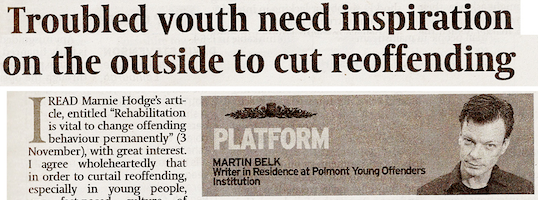
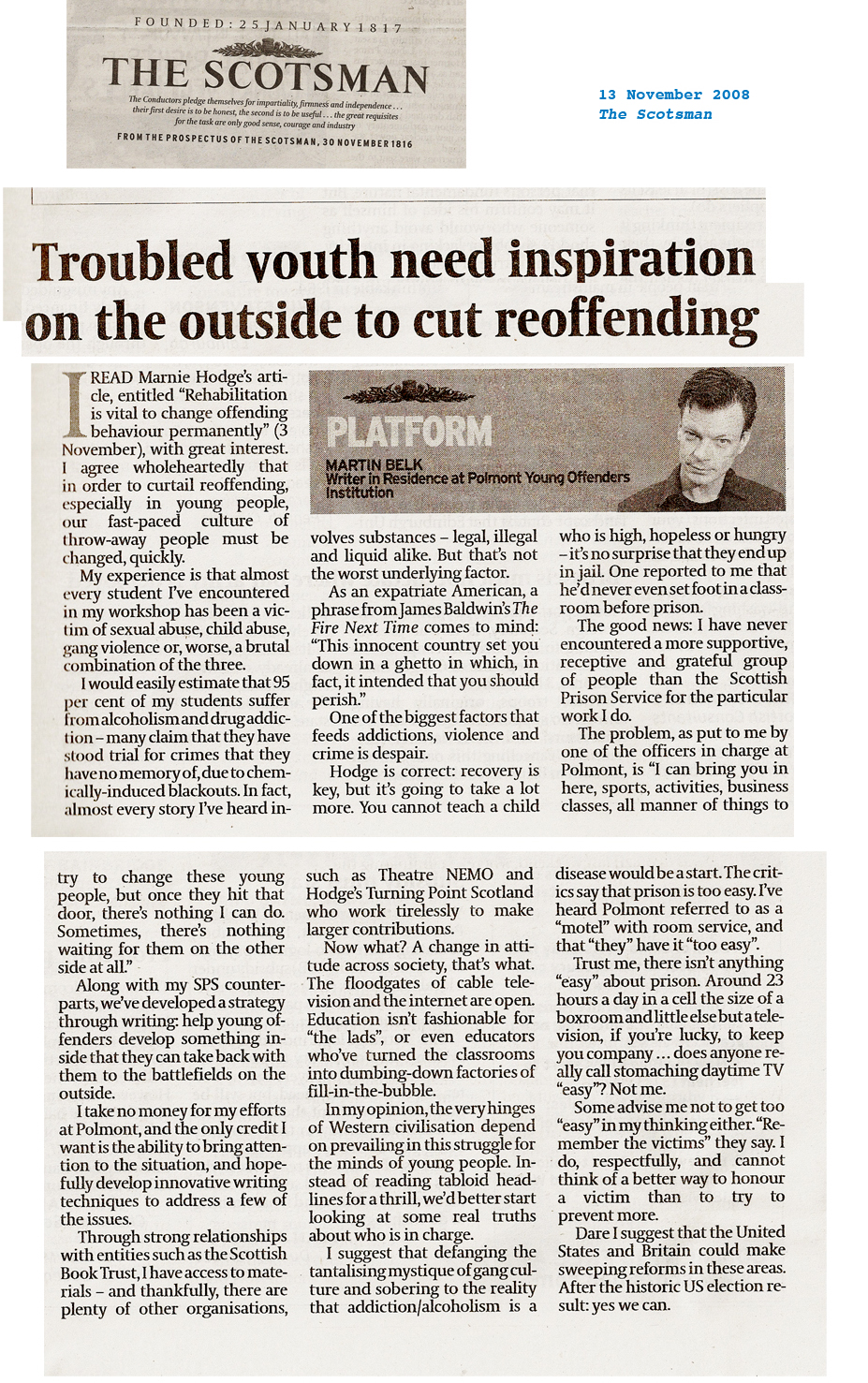
originally published : 13 November 2008 The Scotsman
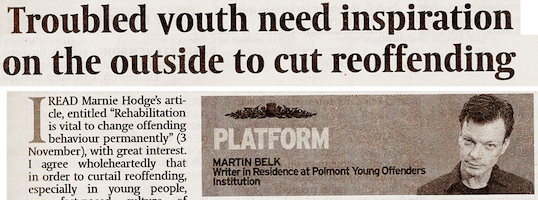
I read Marnie Hodge’s article, entitled “Rehabilitation is vital to change offending behaviour permanently” (3 November), with great interest.
I agree wholeheartedly that in order to curtail reoffending, especially in young people, our fast-paced culture of throw-away people must be changed, quickly.
My experience is that almost every student I’ve encountered in my workshop has been a victim of sexual abuse, child abuse, gang violence or, worse, a brutal combination of the three.
I would easily estimate that 95 per cent of my students suffer from alcoholism and drug addiction – many claim that they have stood trial for crimes that they have no memory of, due to chemically-induced blackouts. In fact, almost every story I’ve heard involves substances – legal, illegal and liquid alike. But that’s not the worst underlying factor.
As an expatriate American, a phrase from James Baldwin’s The Fire Next Time comes to mind: “This innocent country set you down in a ghetto in which, in fact, it intended that you should perish.”
One of the biggest factors that feeds addictions, violence and crime is despair.
Hodge is correct: recovery is key, but it’s going to take a lot more. You cannot teach a child who is high, hopeless or hungry – it’s no surprise that they end up in jail. One reported to me that he’d never even set foot in a classroom before prison.
The good news: I have never encountered a more supportive, receptive and grateful group of people than the Scottish Prison Service for the particular work I do.
The problem, as put to me by one of the officers in charge at Polmont, is “I can bring you in here, sports, activities, business classes, all manner of things to try to change these young people, but once they hit that door, there’s nothing I can do. Sometimes, there’s nothing waiting for them on the other side at all.”
Along with my SPS counterparts, we’ve developed a strategy through writing: helping young offenders develop something inside that they can take back with them to the battlefields on the outside.
I take no money for my efforts at Polmont, and the only credit I want is the ability to bring attention to the situation, and hopefully develop innovative writing techniques to address a few of the issues.
Through strong relationships with entities such as the Scottish Book Trust, I have access to materials – and thankfully, there are plenty of other organisations, such as Theatre NEMO and Hodge’s Turning Point Scotland who work tirelessly to make larger contributions.
Now what? A change in attitude across society, that’s what. The floodgates of cable television and the internet are open. Education isn’t fashionable for “the lads”, or even educators who’ve turned the classrooms into dumbing-down factories of fill-in-the-bubble.
In my opinion, the very hinges of Western civilisation depend on prevailing in this struggle for the minds of young people. Instead of reading tabloid headlines for a thrill, we’d better start looking at some real truths about who is in charge.
I suggest that defanging the tantalising mystique of gang culture and sobering to the reality that addiction/alcoholism is a disease would be a start. The criticism is that prison is too easy. I’ve heard Polmont referred to as a “motel” with room service, and that “they have it too easy”.
Trust me, there isn’t anything “easy” about prison. Around 23 hours a day in a cell the size of a boxroom and little else but a television, if you’re lucky, to keep you company… does anyone really call stomaching daytime TV “easy”? Not me.
Some advise me not to get too “easy” in my doing either. “Remember the victims” they say. I do, respectfully, and cannot think of a better way to honour a victim than to try to prevent more.
Dare I suggest that the United States and Britain could make sweeping reforms in these areas. After the historic US election result: yes we can.

![[PUBLISHED] Ph.D. Thesis: Presenting the Animateur d’Art...](/content/images/size/w600/2026/01/54d8d4a3-9dfb-40ae-be21-b46b8482c396_613x859-jpeg.jpg)
![[BOOKS] 'Back to Start with Lady Bunny', 'What's Left of Leatherdale', A GREAT GAY BOOK: May 2024](/content/images/size/w600/2026/01/b995de77-6f85-4847-9ec0-4f51160c7b39_1044x742-1.png)